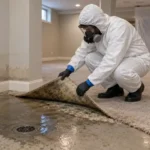
Yes, water damage can weaken ceiling materials and contribute to collapse. Saturated drywall or plaster, damaged attachments, and affected supporting materials can create hazards. A ceiling does not need to be dripping continuously to deserve a careful assessment.
There is no safe universal timeline or stain-size threshold for predicting failure. If the ceiling is sagging, bulging, separating, or visibly changing, keep the area clear and obtain qualified help. The purpose of this guide is to recognize a concerning condition, not teach you to test its strength from underneath.
Moisture can change the ceiling assembly's condition
Wet finishes may lose their ability to remain intact
A ceiling is more than its painted surface. The board or plaster, attachments, framing, and any material above it contribute to how the assembly performs. Water exposure can affect these components differently.
Some damaged materials can be retained after appropriate assessment and drying; others need removal. A contractor should explain the actual findings rather than use the appearance of one stain to predict the entire ceiling's condition.
Concealed wetting can continue beyond visible dripping
Insulation or cavities may remain damp after water stops appearing in the room. The EPA's water-damage guidance distinguishes material-specific responses to clean-water damage.
That guidance does not establish a homeowner's ability to assess structural safety. Where a ceiling appears unstable, access and removal decisions need qualified evaluation before anyone works beneath it.
Treat changes in shape as a warning
Sagging and bulging require clearance rather than testing
Do not press a bulge, puncture a pocket, or climb a ladder beneath weakened material. The action may release water and debris directly onto the person investigating it.
Keep people and pets out of the affected area. If there is an immediate threat to life or broader structural instability, leave the space and contact emergency services or the appropriate qualified safety provider.
Separating seams and falling fragments need attention
Cracks or loose finish can have other causes, but new changes alongside a leak deserve evaluation. Note what changed and when, using photos only from safe positions.
- Keep clear of visibly bowed areas.
- Avoid sleeping or sitting beneath suspect material.
- Do not place buckets where access is unsafe.
- Report new falling debris or expanding damage.
- Tell responders about water near electrical fixtures.
Electrical involvement adds a separate hazard
Water around lights, fans, wiring, or appliances requires caution even when the ceiling itself looks intact. Do not touch wet fixtures or cross water to reach a panel. Switching a wall control off does not establish that concealed wiring is safe.
Qualified electrical help may be needed alongside source repair and restoration. The work should be coordinated so cleanup does not begin under an assumption that another provider already made the area safe.
|
Condition |
Immediate priority |
|
Sagging or bulging ceiling |
Keep occupants away and obtain assessment |
|
Water near lighting or wiring |
Avoid contact and address electrical safety |
|
Active leak without visible deformation |
Control the source safely and evaluate materials |
|
Ceiling fragments falling |
Clear the area and report the change |
|
Documented dry cosmetic stain |
Consider finish repair only after condition is confirmed |
Coordinate source repair with ceiling restoration
Identify what is sending water into the assembly
Roof intrusion, plumbing, appliances, and other sources can produce similar symptoms. The entry point may not be directly above the visible damage because water can travel within the building.
Ask which provider handles the source and which evaluates the ceiling. Ceiling water leak restoration addresses affected materials after the necessary safety and source-control steps.
Call Emergency Restoration Specialists at (414) 571-9977 to discuss a wet ceiling, making any sagging or electrical concerns clear at the start.
Let findings determine removal and drying
Not every wet ceiling requires total replacement. Equally, keeping every material because the leak stopped can overlook weakening or trapped moisture. Ask how the provider evaluates physical condition, contamination, access, and drying readiness.
- Save safe photos and repair findings.
- Clarify why materials are removed or retained.
- Ask about adjoining walls and cavities.
- Keep finishes off materials that are not ready.
- Document scope changes before rebuilding.
Avoid relying on a countdown to decide safety
A search result promising collapse after a certain number of hours cannot evaluate your property. The condition depends on the assembly and exposure. Prompt assessment is more useful than trying to calculate how long you can leave the room occupied.
The ERS team can discuss restoration after water enters a ceiling. Call (414) 571-9977 for property concerns, and prioritize emergency or qualified safety help when there is an immediate hazard.
Frequently Asked Questions
Can a ceiling fail after the dripping stops?
It can remain weakened after the source stops. The absence of dripping does not establish the physical condition of saturated materials or attachments.
How many hours until a wet ceiling collapses?
There is no universal safe countdown. Material, construction, saturation, and damage differ; changing shape or instability requires clearance and assessment rather than waiting for a predicted deadline.
Does a small stain mean low risk?
Not necessarily. Visible stain size does not measure concealed wetting or the entire assembly. Consider shape changes, leak history, and qualified findings together.
Should I drain a ceiling bubble myself?
No. Puncturing weakened material can release water and debris and expose concealed hazards. Keep clear and let qualified providers plan access.
Can I sleep in the affected room?
Do not occupy a space beneath sagging or suspect ceiling material while its condition is unresolved. Ask the appropriate professional about safe access and use.
Are plaster ceilings immune to water damage?
No ceiling material should be assumed immune. The assembly, attachments, and exposure still need evaluation when water damage or instability is present.
Should I turn off a wet light switch?
Do not touch wet electrical controls or fixtures. Obtain appropriate safety assistance instead of assuming that operating a switch resolves the electrical risk.
Does every water-damaged ceiling need full replacement?
No. Retention depends on actual material condition and drying feasibility. Ask for an explained scope rather than an automatic replacement decision.
What if new cracks appear after a leak?
Report the change and avoid disturbing the area. Cracks have multiple possible causes, but new cracking with moisture deserves qualified evaluation.
Who should inspect the ceiling?
Restoration and relevant building professionals may need to coordinate with plumbing, roofing, or electrical providers. Immediate hazards may require emergency assistance before the restoration visit.
Related posts:
![When Wind Opens a Multifamily Roof: A First-Day Action Plan]()
When Wind Opens a Multifamily Roof: A First-Day Action Plan
![Water Damage vs Flood Damage: What Is the Difference?]()
Water Damage vs Flood Damage: What Is the Difference?
![Toilet Overflow Moisture Mapping: Set the Cleanup Boundary]()
Toilet Overflow Moisture Mapping: Set the Cleanup Boundary
![How to Fix (Thaw) Frozen Pipes Without Bursting Them]()
How to Fix (Thaw) Frozen Pipes Without Bursting Them
![What To Verify Before Sewage Damaged Materials Are Removed]()
What to Verify Before Sewage-Damaged Materials Are Removed
![Can-Water-Damaged-Drywall-Be-Saved-or-Should-It-Be-Replaced]()
Can Water-Damaged Drywall Be Saved or Should It Be Replaced?
![2.-What-Should-I-NOT-Do-After-Water-Damage]()
After Water Damage, These Mistakes Make It Worse