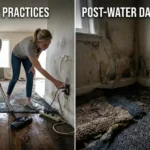
There is no universal square-foot limit that makes water damage safe to repair yourself. A small amount near electricity or involving sewage can be more concerning than a larger clean-water spill on a suitable hard surface. The source and material conditions matter as much as volume.
Before starting cleanup in your Wisconsin home, ask whether the water has stopped, whether access is safe, and whether moisture reached concealed layers. If those questions cannot be answered confidently, an assessment may be more useful than renting equipment and hoping the surface dries.
Start with safety rather than the puddle's size
Electrical and structural concerns override DIY plans
Avoid water near outlets, appliances, wiring, or panels. Keep clear of sagging ceilings and unsafe flooring. Do not enter a hazardous space to reach a shutoff or place drying equipment.
If there is an immediate threat, obtain the appropriate emergency or qualified safety help. A household cleanup plan is not suitable until the area can be accessed safely.
The water source affects the cleanup boundary
Known clean water, sewage, outdoor floodwater, and an unknown source require different judgments. Water can also change as it contacts materials and remains in the building, so an original clean supply does not excuse ignoring present conditions.
The EPA's homeowner guidance recommends experienced professional help for sewage or other contaminated-water damage. Do not treat those incidents as ordinary surface spills.
Determine which materials became wet
Limited surface exposure differs from an affected assembly
A small promptly controlled spill on an appropriate hard surface may be manageable when there are no hazards and no absorbed moisture. A wet wall cavity, carpet padding, or layered floor requires a different evaluation.
The EPA's material-response table shows why material type influences the response. It does not establish that every homeowner can assess hidden conditions without assistance.
Physical changes can indicate a broader problem
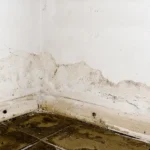
Swollen trim, lifted flooring, softened drywall, and recurring stains deserve attention. Those changes can remain after surface water disappears and may require repair beyond drying alone.
- Identify affected finishes and adjoining rooms.
- Note water entering beneath or behind materials.
- Record recurring wetting from the same source.
- Avoid opening assemblies around concealed hazards.
- Ask whether retention is feasible for each material.
Compare your situation with practical response boundaries
|
Condition |
Why qualified help may be useful |
|
Unknown or contaminated water |
Cleaning and disposal decisions differ from a clean spill |
|
Wet ceiling or wall cavity |
Concealed spread and access need assessment |
|
Layered flooring |
Surface appearance may not reflect underlying moisture |
|
Persistent wetness or recurrence |
Source or drying conditions may remain unresolved |
|
Electrical or structural concern |
Safety must be addressed before cleanup |
Discuss water damage restoration with ERS at (414) 571-9977 when the incident exceeds a limited, safe surface task.
Equipment is useful only within an appropriate plan
A dehumidifier does not identify the moisture pathway
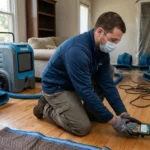
Equipment can support drying, but it cannot tell you which cavity is wet or which material is damaged. A domestic unit's tank filling shows water removed from air, not that every affected layer is ready.
Ask how the setup fits the room, materials, and access. Equipment capacity and operating conditions matter, and electrical use must be safe.
Progress needs a basis beyond appearance
The question is not simply whether the room feels comfortable. Appropriate evaluation should establish whether retained materials are responding and whether additional access or removal is needed.
Avoid leaving the same setup running indefinitely because you do not know what constitutes completion. A provider should explain the proposed drying goal and how the plan changes if progress is insufficient.
Know what to ask before approving restoration work
Request a clear scope tied to the source, affected materials, and findings. Not every water incident calls for extensive demolition, but a low-cost surface treatment should not overlook concealed exposure.
- Which rooms and layers are included?
- What can stay and what needs removal?
- Who corrects the water source?
- How is drying readiness evaluated?
- What repairs remain after mitigation?
Keep safe photos, source-repair findings, and estimates together. If a claim is involved, ask the insurer about documentation before nonurgent disposal or permanent repairs without ignoring necessary safety action.
Make the decision based on what you can establish
DIY limits depend on the condition, not a universal repair-price threshold or the number of towels needed. A safe, known surface spill is different from a leak entering layers you cannot evaluate.
The ERS team can discuss restoration needs where the spread or material condition is uncertain. Call (414) 571-9977 before replacing finishes over dampness or treating contaminated water as a routine household cleanup.
Frequently Asked Questions
Is there a safe DIY square-foot limit?
Not one that applies to every water incident. Source, safety, materials, and concealed spread can matter more than the visible area.
Can a small sewage spill be handled like clean water?
No. Contamination changes cleanup and material decisions. Obtain experienced professional advice instead of relying on puddle size to decide the risk.
Does renting equipment make the job manageable?
Equipment helps only when the scope and safety conditions are understood. It does not identify hidden moisture or establish which materials can be retained.
Can I clean water near an outlet myself?
Do not approach wet electrical equipment or wiring. Obtain appropriate safety assistance before cleanup or equipment use in the affected area.
Is wet carpet only a surface problem?
Not necessarily. Backing, padding, and the floor beneath may be affected. The source and material condition determine what can be cleaned or dried appropriately.
Do I need full demolition for every leak?
No. The scope should be based on findings. Ask why each removal is necessary and whether appropriate drying in place is feasible.
Can a repaired leak still require restoration?
Yes. Source repair stops additional water but does not remove moisture already in building materials. Evaluate both parts of the incident.
How do I know when the area is ready?
Ask how the material condition is evaluated. Surface appearance, smell, and equipment runtime alone cannot establish every layer's readiness.
Should I wait until mold appears to get help?
No. Wet materials and hidden exposure warrant attention before visible growth. Prompt assessment supports decisions without relying on mold as the first warning.
What if I already started and the area stays damp?
Stop guessing about the drying plan and arrange reassessment. Persistent moisture can indicate inadequate access, equipment mismatch, or an unresolved source.
Related posts:
![3 Ways To Help Prevent Water Damage In Your Home]()
3 Ways To Help Prevent Water Damage In Your Home
![How Does Water Damage Your Basement?]()
How Does Water Damage Your Basement?
![Spring-Hail-in-Milwaukee-What-Small-Exterior-Hits-Turn-Into-Bigger-Interior-Problems-Later]()
Spring Hail in Milwaukee: Small Hits, Bigger Problems Later
![Preventing-Secondary-Water-Damage-After-Initial-Cleanup]()
Preventing Secondary Water Damage After Initial Cleanup
![2.-How-To-Tackle-Water-Damage-Repair-in-Older-Homes]()
Older Homes and Water Damage: What to Do First
![How-to-get-water-out-of-Flooded-Carpets]()
How to Get Water Out of Flooded Carpets: A Step-by-Step Guide
![2.-What-Should-I-NOT-Do-After-Water-Damage]()
After Water Damage, These Mistakes Make It Worse