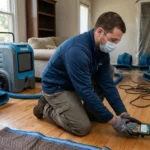
Run a dehumidifier as part of an appropriate drying plan until the affected materials are ready, rather than for a universal number of days. The water source, saturation, material layers, room conditions, and equipment capacity all influence the process.
A filling tank shows that the unit is removing moisture from the air. It does not prove that the wall cavity, carpet padding, or floor beneath a finish is dry. Wisconsin homeowners should understand what the equipment is intended to accomplish before treating runtime as a completion test.
Control the water source before judging drying progress
Ongoing entry can keep adding moisture
A leaking pipe or roof can replace moisture as the unit removes it. Stop the source safely and obtain the appropriate plumbing or roofing repair. If the source remains uncertain, investigate it rather than increase equipment runtime indefinitely.
Record when the source was controlled and what materials were affected. The discovery time may not show when concealed wetting began, so avoid calculating the entire exposure from when you first saw the puddle.
Standing water and absorbed moisture are different tasks
Removing accessible excess water and drying materials are related steps, but a dehumidifier does not substitute for extraction. Contamination and electrical safety also affect what equipment can be used.
The EPA's flood-cleanup guidance addresses safety and drying after flooding. A known plumbing leak requires its own source and material assessment rather than assuming every flood procedure applies unchanged.
Match equipment to the materials and environment
A room-sized unit may not address concealed layers
Domestic dehumidifiers and restoration equipment have different capabilities and operating conditions. A small unit in the hallway may not create suitable drying conditions for a wet floor assembly or enclosed cavity.
Discuss water-damage equipment rental with ERS at (414) 571-9977. Ask about appropriate use, setup instructions, and whether the damage needs assessment beyond equipment hire.
Airflow, temperature, and access influence the result
Dehumidification removes moisture from air while airflow and material exposure influence evaporation. A closed layer can remain wet even in a room with lower humidity. The drying plan should address the actual assembly rather than only the room air.
- Identify wet materials before placing equipment.
- Use equipment only where electrical conditions are safe.
- Follow instructions for drainage and operating conditions.
- Keep the setup suitable for the affected space.
- Ask how progress will be evaluated.
Use material findings rather than a preset deadline
|
Observation |
What it means for runtime decisions |
|
Tank continues filling |
Moisture is being removed from air, not proof of all material conditions |
|
Room humidity improves |
Useful environmental change, but concealed layers still matter |
|
Surface feels dry |
A limited observation rather than an assembly-wide test |
|
Material remains wet |
The setup or access may need adjustment |
|
Source continues leaking |
Source control remains necessary |
The EPA's material-response guidance shows why different materials need different treatment. Retention, removal, and drying are decisions tied to condition and water source.
Know when continued runtime is not solving the problem
Persistent dampness deserves reassessment
If the same area stays wet, ask whether the source is active, the capacity is suitable, or moisture is trapped beneath a finish. Leaving the equipment unchanged for longer may not answer those questions.
Odor and surface appearance are limited checks
A better smell does not prove that all materials are ready. A musty odor can justify investigating dampness, but it cannot identify a species or establish the exact affected area.
The EPA's moisture guide recommends prompt attention to wet materials. Its prevention timeframe is not a universal drying guarantee or a reason to declare every assembly complete after two days.
Clarify what the rental or restoration scope includes
Ask whether the service provides equipment only, setup help, material assessment, monitoring, or a broader restoration plan. Those are different scopes and should be described clearly.
- Confirm safe electrical and drainage requirements.
- Ask who checks affected cavities or floor layers.
- Record equipment changes and relevant findings.
- Keep source-repair records with drying documentation.
- Confirm readiness before installing new finishes.
Avoid unauthorized changes to a professional setup. If a contractor is managing the job, ask before turning units off or relocating them because the room feels comfortable.
Make the stopping decision part of the original plan
The ERS team can discuss equipment and property needs after a water incident. A useful plan explains what is wet, how the equipment addresses it, and what establishes that retained materials are ready.
Call (414) 571-9977 if runtime is becoming a guess or moisture remains after the visible water is gone. The goal is appropriate drying, not keeping a machine running for an arbitrary period.
Frequently Asked Questions
Is three days enough for every leak?
No. Saturation, materials, access, and equipment conditions vary. Use the property's drying progress rather than a universal runtime.
Does a full tank mean the floor is drying?
It shows water removed from air, but not the condition of every floor layer. Material evaluation is needed to determine readiness.
Can I stop when room humidity improves?
Improved humidity is useful, but concealed moisture can remain. Ask how the affected materials are assessed before making the stopping decision.
Does a dehumidifier remove standing water?
It is not a replacement for appropriate extraction. Source control, excess-water removal, and material drying are distinct parts of the response.
Should windows stay open during drying?
That depends on the drying setup and outdoor conditions. Follow equipment or provider instructions instead of assuming open windows always help.
Can equipment dry sewage-soaked materials?
Drying alone does not address contamination. Obtain experienced professional advice about cleaning, removal, and material retention for that incident.
Why does the same wall remain damp?
An active source, trapped moisture, or an unsuitable setup may be involved. Reassessment is more useful than indefinitely repeating the same equipment arrangement.
Should I move a contractor's dehumidifier?
Ask the managing provider first. Placement may be part of a coordinated plan, and moving or switching equipment can change conditions.
Does rental include moisture monitoring?
Not automatically. Clarify whether the agreement covers equipment only or additional assessment and monitoring before assuming those services are included.
When can finishes be installed again?
After source control and appropriate material readiness are established. Equipment runtime alone should not determine when a cavity closes or flooring is replaced.
Related posts:
![Preventing-Secondary-Water-Damage-After-Initial-Cleanup]()
Preventing Secondary Water Damage After Initial Cleanup
![Your Property's Foundation & Water Damage]()
Your Property's Foundation & Water Damage
![How to Prevent Ice Dams: A Milwaukee Homeowner's Pre-Winter Checklist]()
How to Prevent Ice Dams: A Milwaukee Homeowner's Pre-Winter Checklist
![How Frozen Pipes Can Cause Water Damage]()
How Frozen Pipes Can Cause Water Damage
![Final-Inspection-Checklist-After-Water-Damage-Restoration]()
Final Inspection Checklist After Water Damage Restoration
![How-to-Protect-Your-Furniture-from-Flood-Water]()
How to Protect Your Furniture from Flood Water
![3.-Seasonal-Water-Damage-Restoration-Repair-Tips]()
Seasonal Water Damage Repair Tips for Storms and Freezes